Plan
Define the purpose, scope, criteria, timing, locations, departments, audit method and team.
FlinkISO · Free Open Source QMS
Plan the audit, work through controlled checklists, record findings and configure the module around your own QMS workflow.
Document-backed and configurable
The Audit Programme and Schedule is the parent record for the audit. It identifies the applicable standard, audit type, risk priority, objective, scope, criteria, dates, locations, departments, lead auditor, audit team, auditee representative and current status.
Audit Checklist and Audit Findings are linked Child Document Forms. Each uses its own controlled document, generated HTML form, database table, record history and API-editable JSON definition while remaining connected to the parent audit.
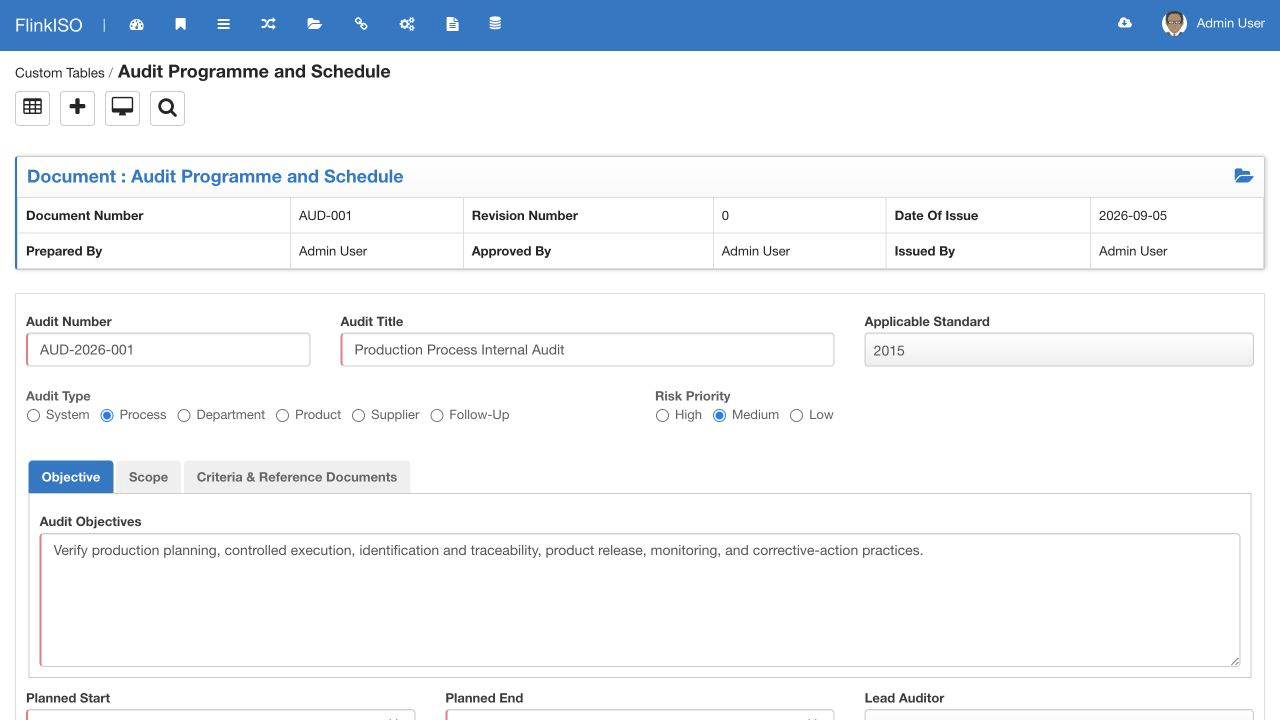
A connected audit cycle
Status is more than a label. It controls which parts of the audit are available as work moves forward.
Define the purpose, scope, criteria, timing, locations, departments, audit method and team.
Confirm participants and make the controlled Audit Checklist available for preparation.
Record clause-based questions, objective evidence, samples, interviewees and results.
Issue findings, capture responses and evidence, verify effectiveness, conclude and approve the audit.
Three controlled records
The parent document and form. It controls planning information, responsibility, status, conditional tabs and access to linked audit records.
A Child Document Form for repeatable clause or requirement checks, audit questions, evidence, sample references, results, auditor and completion date.
A Child Document Form for findings, requirements not met, responsible people, correction, auditee response, closure evidence, verification and effectiveness.
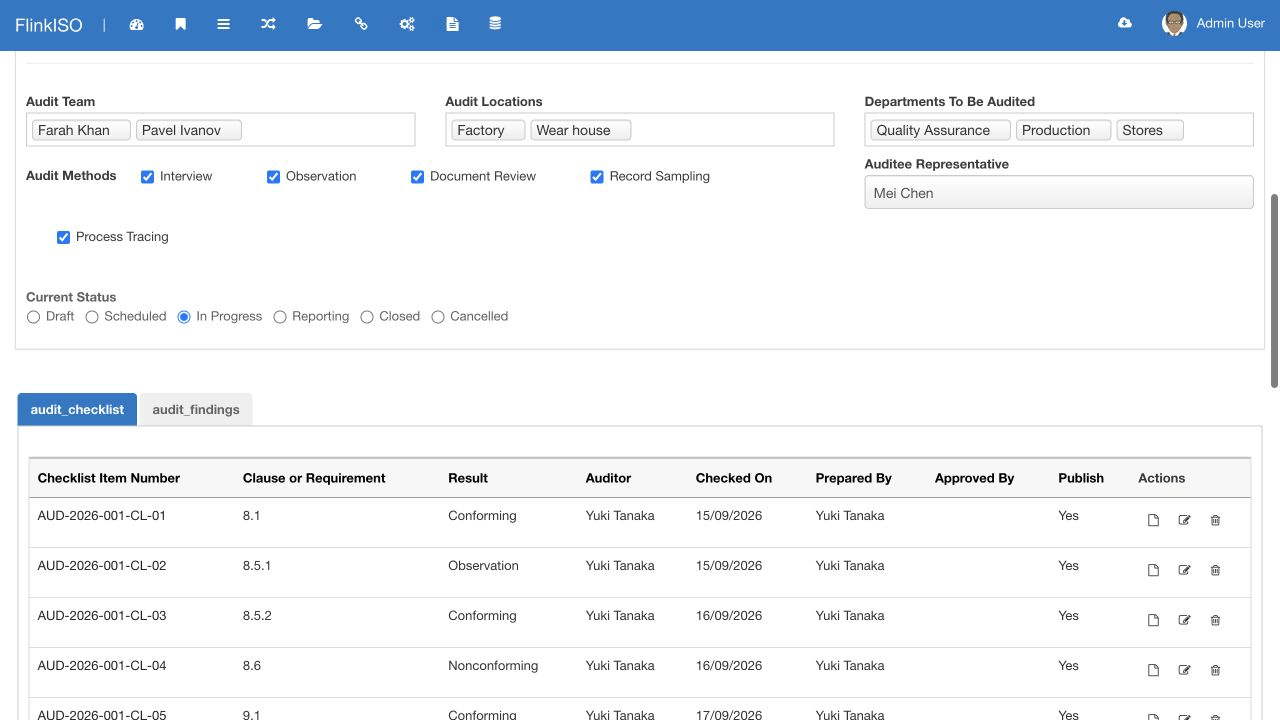
Example visibility model
Administrators can change these rules. The supplied configuration demonstrates a practical ISO 9001 audit flow.
| Status | Main-form tabs | Child documents | Typical work |
|---|---|---|---|
| Draft | Objective, Scope, Criteria & Reference Documents | Hidden | Develop the audit plan before releasing operational records. |
| Scheduled | Planning tabs | Audit Checklist | Prepare the checklist and confirm the audit arrangements. |
| In Progress | Planning tabs | Audit Checklist and Audit Findings | Perform the audit, retain evidence and raise findings. |
| Reporting | Planning tabs and Conclusion | Audit Checklist and Audit Findings | Complete the report, responses, verification and conclusion. |
| Closed | Planning tabs and Conclusion | Audit Checklist and Audit Findings | Retain the completed controlled record and approval history. |
| Cancelled | Planning tabs | Hidden | Keep the cancelled schedule without opening operational work. |
Each field can be editable by the creator, preparer, approver or an employee selected in a responsibility field such as Lead Auditor, Auditor, Responsible Person or Verified By. Administrators can also grant editing to selected designations; other users see that field as disabled even when they can open the record.
Configuration without a separate code fork
The installed audit module is driven by its saved form definitions. Use the module configuration page and Form Creation API to update the main form and both Child Document Forms.
After structural or layout changes, Rebuild Module regenerates the main form and linked forms from their saved definitions while keeping the existing custom-table records connected.
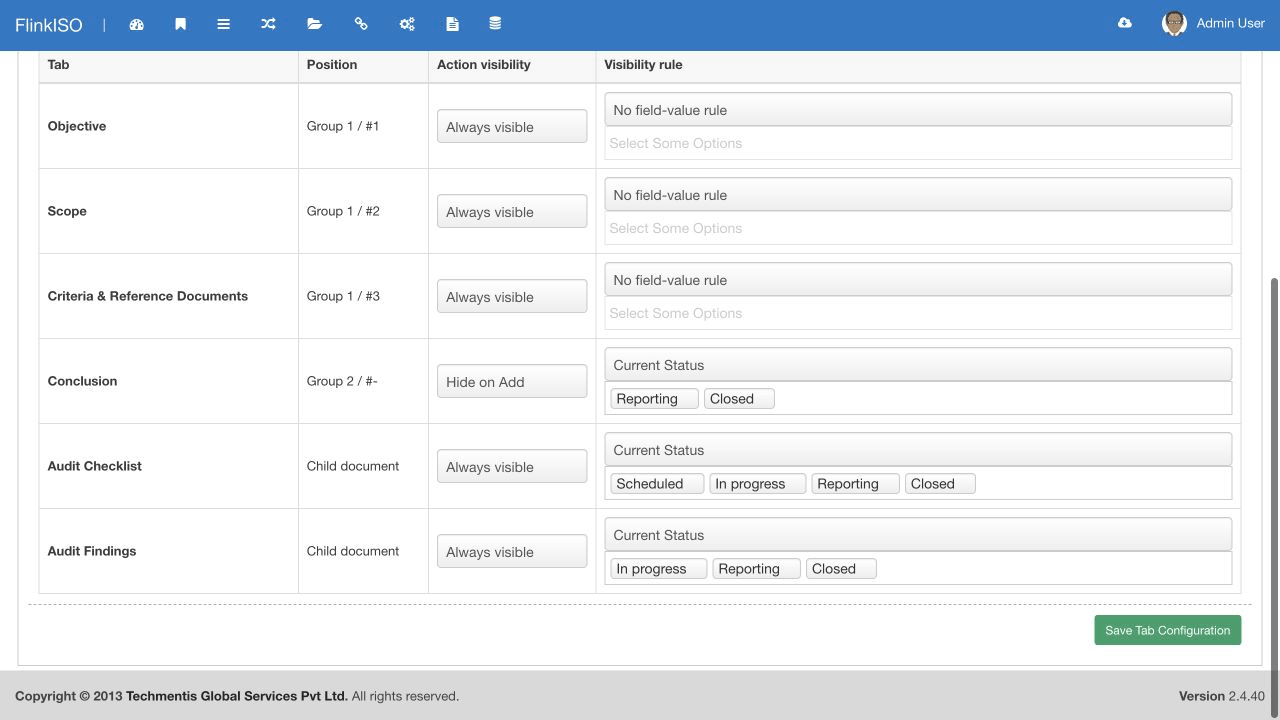
Notifications
Create rules on the parent audit, checklist or findings form according to the event and audience that need the message.
Messages can include values such as {{module.name}}, {{record.id}}, {{record.FIELD_NAME}}, {{changes.FIELD_NAME.old}}, {{changes.FIELD_NAME.new}}, {{actor.name}} and {{reminder.target_date}}.
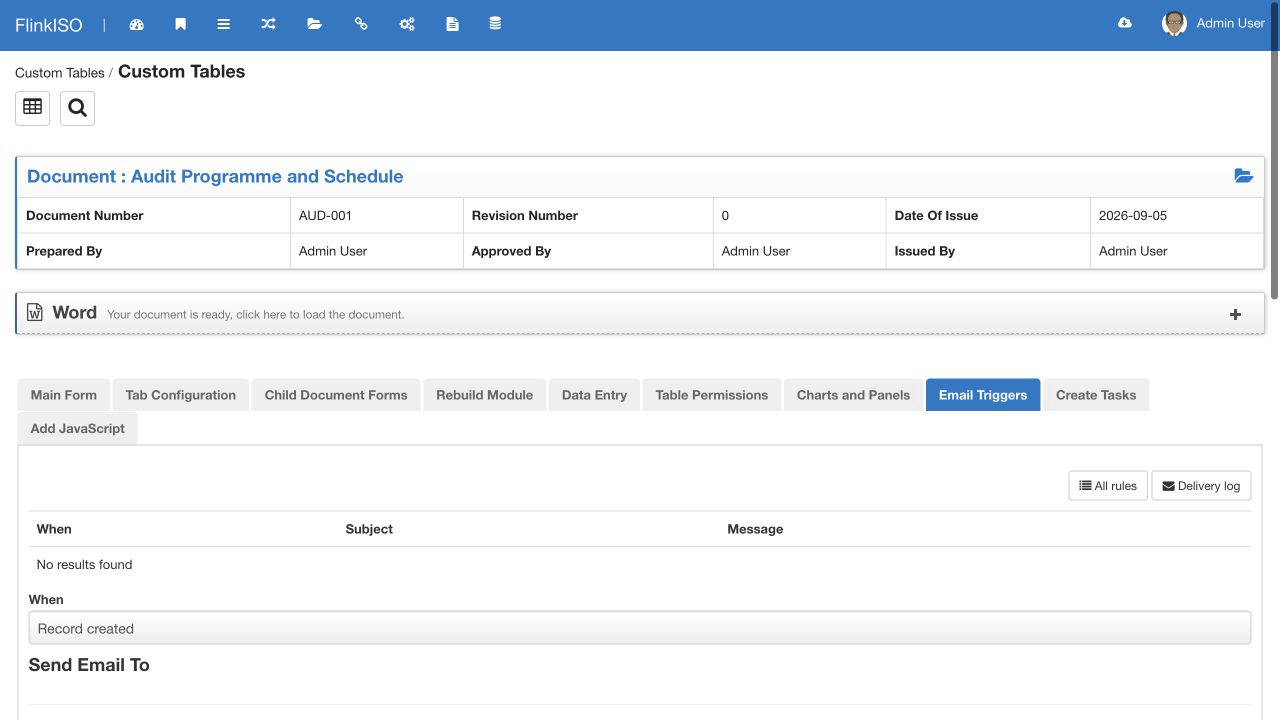
Assigned follow-up
A task rule turns a meaningful audit condition into assigned work with a target date and dashboard visibility.
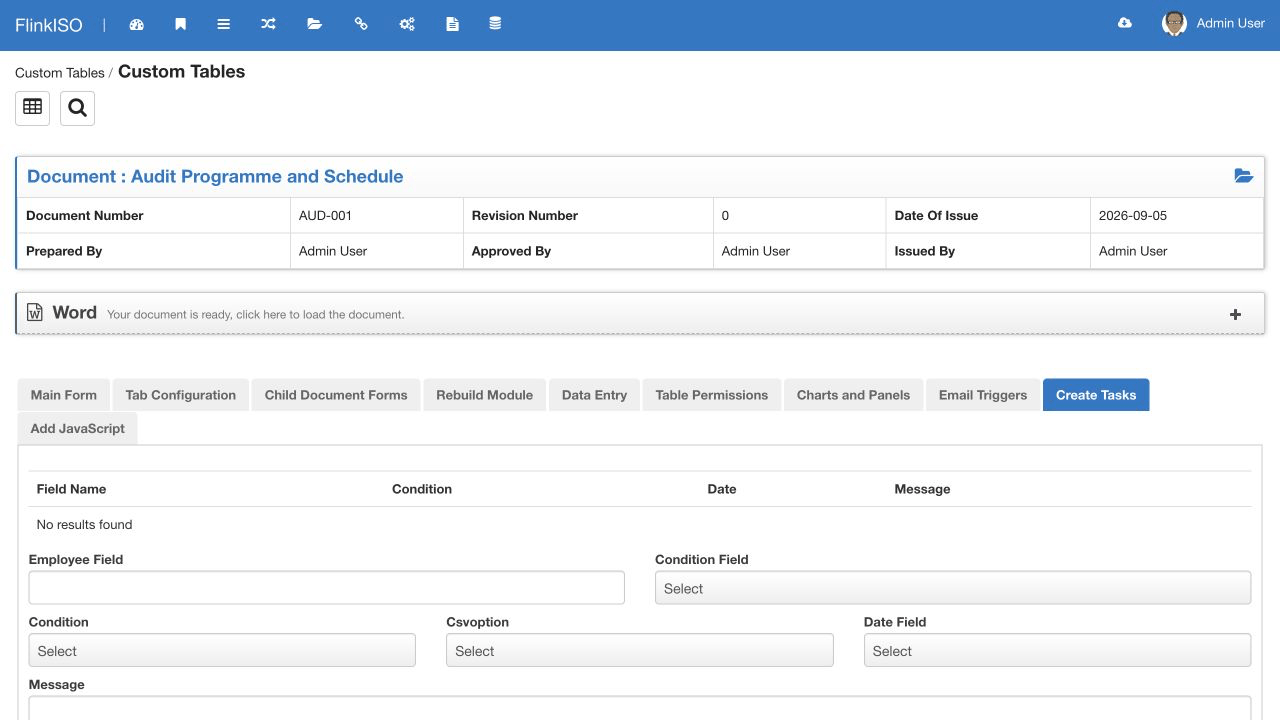
When the saved condition is met, the task is assigned to the employee referenced by the record, appears on that employee’s dashboard and sends the task notification email. Do not create a second email trigger for the same task condition unless a different audience or message is required.
Approvals and release
Attach the appropriate process to the form. Each configured step displays its own name and can request the relevant reviewer, HoD, approver, designation or user.
Combine table permissions, approval roles and field-specific editor or designation rules so each participant can change only the information assigned to them.
Keep comments, prepared-by and approved-by identities, approval history, controlled documents and linked child records with the audit.
Ready to use. Ready to adapt.
These readily available forms are created within the system without any coding. Similar to these forms, you can create your own forms & modules on-the-fly without any help from experts and with zero-coding.
You can customize all these existing modules & forms without any coding. You can add/ remove fields, change field locations, resize them, hide/ show fields on index page, restrict users from editing fields etc. You can also add your own business rules, email notifications, custom alerts & tasks and much more.
More from FlinkISO
In their own words
Testimonials
We’ve been using FlinkISO for about a year, and it has become a key tool for managing our QMS for ISO 9001 and ISO 27001.
The platform is powerful yet straightforward—easy to navigate, quick to understand, and practical for day-to-day work. The team support is also excellent: fast, responsive, and genuinely helpful whenever we need it.
Overall, it’s a highly reliable solution and, in our experience, one of the best QMS tools available today.
The FlinkISO Online System certainly has revolutionized our business, it certainly allows us to work "smarter, not harder".
The online tracker, database, reports and graphs etc, have outperformed our initial system.
All the documentation is accessible at the press of a button, needless to say we are proud to be affiliated with you and with this level of professionalism.
We have been using FlinkISO as our Quality Management Software for the past few years and we are extremely satisfied with the software and services offered.
The support team installed the software for us and worked with us to customize our Quality Management website which made the transition from a paper-based system to an online one effortless.
They always respond promptly to any questions or inquiries and have processed our web customization requests with speed and reliability.
I would highly recommend their services.







Start your 15 days On-Cloud QMS trial. No payment required. One free training session included. Live chat & email support.
RegisterDownload Free Quality Management Software On-Premise Edition. Installation, Training, Support Services on-demand.
Free Download